The Enclothed Cognition Hack: Why WFH Professionals Need to Put Their Shoes On
Have you ever spent an entire work-from-home day in your slippers, only to realize by 3 PM that your focus is completely shot and you've spent more time browsing news feeds than writing code or managing sprints?
You are not alone. And the solution isn't a new time-tracking app or more caffeine. The solution is simple: put your shoes on .
What is Enclothed Cognition?
In 2012, researchers Hajo Adam and Adam D. Galinsky coined the term "enclothed cognition" to describe the systematic influence that clothes have on the wearer's psychological processes.
Their study showed that wearing specific clothing items alters your mental state. When participants were given a white lab coat and told it was a doctor's coat, their selective attention increased sharply. When told the exact same coat was a painter's coat, they did not show the same attentional spike.
The clothing itself has no magical powers. Rather, it is the symbolic meaning your brain associates with that clothing.
The WFH Slipper Trap
When you work in an office, you wear office attire. Your brain associates business casual, slacks, and dress shoes with focus, accountability, and execution.
When you transition to working from home, it is incredibly tempting to embrace the comfort of sweatpants and slippers. But here is the psychological catch-22: * Slippers and sweatpants represent comfort, relaxation, and winding down. * Work requires focus, intensity, and executive function.
By wearing relaxation clothing during work hours, you create a cognitive dissonance. Your brain is getting conflicting signals. It wants to relax because of what you're wearing, but it needs to perform because of your responsibilities. You end up wasting precious willpower just trying to stay focused.
Enter the Shoe Hack
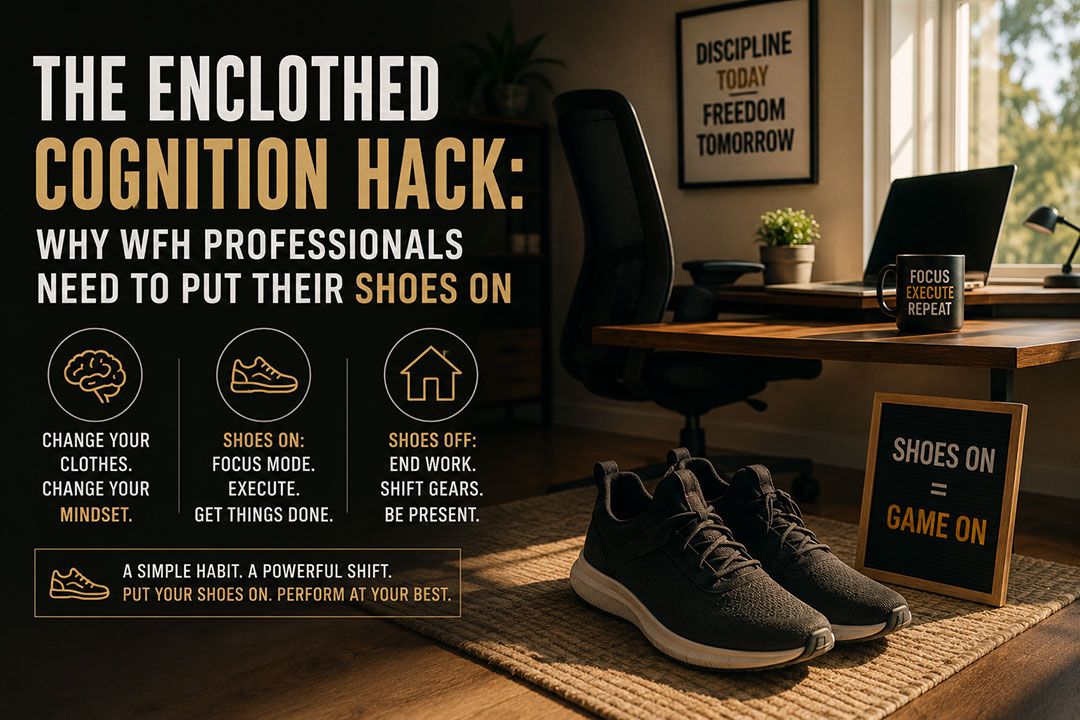
The easiest way to break this cognitive dissonance is to put on real, outdoor-style shoes .
They don't have to be dress shoes—clean sneakers, boots, or loafers work perfectly. The key features are: 1. Laces or structure: They must feel firm and supportive. 2. Sole: A hard rubber or leather sole that makes a distinct sound when you walk.
The moment you lace up your shoes, several psychological shifts occur: * Physiological posture: Shoes change how you sit and stand. You sit more upright, which naturally increases blood flow and alertness. * Spatial boundary: It signals to your brain that you are "at work" even if your office is five feet from your bed. * The "Leaving the House" Trigger: Your brain associates putting on shoes with going out to accomplish tasks. It primes you for activity.
How to Implement the Shoe Code
To get the maximum productivity benefit out of this hack, establish a strict boundary:
- The Morning Pivot: Wake up, do your morning routine, and before sitting down at your keyboard, put on your shoes. This is your "commute."
- The Hard Stop: The moment your workday ends, take your shoes off. This is your "evening commute." It immediately signals to your brain that it is safe to relax, helping you avoid WFH burnout by separating work-time from life-time.
Try it tomorrow. Put on a pair of clean sneakers before you open your laptop, and watch how quickly your brain snaps into executive mode.
Remember: Put your shoes on.
Direct Answer / Executive Summary
xplore the psychological phenomenon of enclothed cognition and how wearing real shoes at home shifts your brain into high-performance executive mode.
Key Takeaways
- ▪ Have you ever spent an entire work-from-home day in your slippers, only to realize by 3 PM that your focus is completely shot and you've spent more time browsing news feeds than writing code or managing sprints?
- ▪ You are not alone.
- ▪ In 2012, researchers Hajo Adam and Adam D.