Why Walking Solves Problems Sitting Never Will
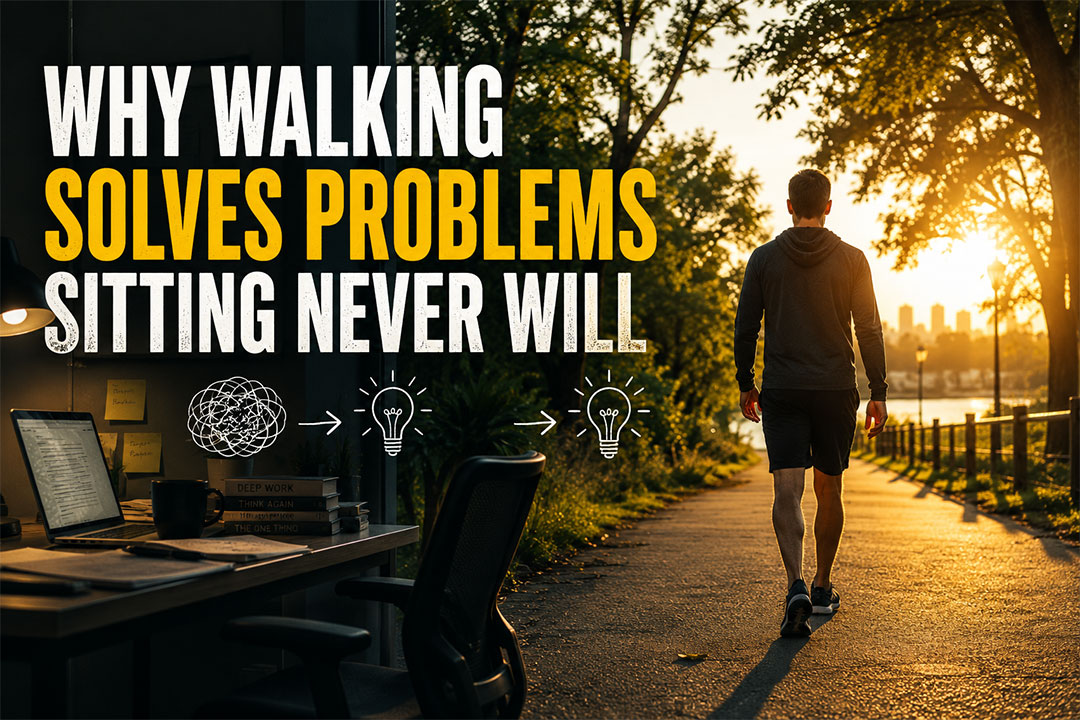
You've been staring at the same screen for nearly an hour.
The code still isn't working.
The email still won't write itself.
The design still feels off.
The answer is somewhere in your head, but the harder you think, the further away it seems.
Frustrated, you push your chair back, walk outside, and start down the sidewalk.
Halfway to the corner, the solution appears.
It feels almost magical.
It isn't.
Your brain was simply waiting for you to move.
Your Brain Was Never Designed to Think in One Place
Modern work encourages us to believe that the best thinking happens while sitting perfectly still at a desk.
But for most of human history, people solved problems while moving through the world.
Hunters tracked animals across miles of terrain. Builders planned structures while walking job sites. Inventors paced workshops. Philosophers taught while strolling through gardens.
Movement wasn't a distraction from thinking.
It was part of the thinking process.
Today, we often spend hours staring at the same screen in the same chair, expecting fresh ideas to appear without changing anything around us.
Sometimes the environment is the problem.
Sitting Keeps You Inside the Same Mental Loop
When you're stuck, your instinct is usually to work harder.
Read the paragraph again.
Look at the spreadsheet one more time.
Run the code again.
The problem is that your brain keeps receiving the exact same visual cues and following the exact same thought patterns.
You become trapped in a mental loop.
Walking interrupts that loop.
A change of scenery gives your brain new sensory input while reducing the intense focus that can sometimes prevent creative thinking.
Instead of forcing an answer, you give your mind room to discover one.
Your Brain Keeps Working Even When You're Not
Have you ever solved a problem in the shower?
Or while driving?
Or walking the dog?
That happens because your brain doesn't stop working the moment you stop actively concentrating.
When you step away from a difficult problem, your mind continues processing it in the background.
Psychologists often call this incubation .
Your conscious attention relaxes, but your brain continues searching for connections and possibilities.
Walking creates the perfect conditions for that process.
Your body has something simple to do.
Your mind is free to wander just enough to find a different path.
Movement Sparks Creativity
Walking isn't just good for your body.
It can also encourage more flexible thinking.
Researchers have found that people often generate more creative ideas while walking than while sitting still.
You don't need to hike a mountain or train for a marathon.
A short walk around the block can be enough to help your brain break free from rigid thinking patterns.
Sometimes changing your pace changes your perspective.
Leave Your Phone in Your Pocket
This part matters.
The goal isn't to replace your computer with your phone.
If you spend your walk scrolling social media, answering messages, or watching videos, your brain never gets the quiet space it needs.
Instead, try walking without filling every second.
Look around.
Notice the weather.
Listen to the sounds around you.
Let your thoughts wander naturally.
Boredom isn't something to avoid.
It's often where your best ideas begin.
The 10-Minute Walking Cheat Code
The next time you feel stuck, try this:
- Work on the problem for about 20 to 30 minutes.
- If you're still spinning your wheels, stop.
- Leave your desk.
- Walk for 10 minutes without checking your phone.
- Don't force yourself to think about the problem.
- Let your mind wander.
When you return, start working again before checking email or opening another distraction.
You may not solve every problem on every walk.
But you'll be surprised how often the answer finds you when you stop chasing it.
Your Next Step Is an Actual Step
When you're stuck, your first instinct is usually to sit longer and think harder.
Your brain often wants the opposite.
It wants new surroundings.
Fresh sensory input.
A change of pace.
Permission to stop forcing the solution.
The next breakthrough probably isn't hiding somewhere on your screen.
It might be waiting at the end of your driveway.
The next time your mind feels stuck, don't reach for another cup of coffee or open another browser tab.
Take a walk.
Sometimes your next step toward the answer is an actual step.
Direct Answer / Executive Summary
You've been staring at the same screen for nearly an hour.
Key Takeaways
- ▪ You've been staring at the same screen for nearly an hour.
- ▪ The code still isn't working.
- ▪ The email still won't write itself.